

Pharmacovigilance, a vital discipline, ensures patient safety by systematically monitoring and assessing risks and benefits throughout a pharmaceutical product's life cycle. Through real-world data analysis, it identifies safety concerns, guides regulatory decisions, and fosters healthcare improvement by maintaining a vigilant focus on drug safety. Generative AI is poised to transform pharmacovigilance, automate adverse event detection, improve signal detection, expedite vast dataset analysis, and amplify the efficiency of drug safety monitoring.
Generative AI (Gen AI) has captured widespread attention for its transformative potential. As we delve into Gen AI's ability to reshape industries, I've engaged in insightful conversations with life-science innovators. Amidst their cautious enthusiasm, one question resonates: when will Gen AI be operational? I believe it will not be too long at the current pace of development! Gen AI will be ready for real-world production use cases in months if not weeks. With the proper instructions and training, these models can carry out tasks accurately with predictability and consistency.

The innovation is real, and it is here! Healthcare, Retail, Manufacturing, BFSI, Education, we have seen significant momentum across the board. It is a boardroom conversation, unlike other technologies that have emerged so far. Every single business is either experimenting, ideating, or in the construction phase.
– Sandeep Alur
Director – Microsoft Technology Center.
So, to explore the potential of Gen AI, Indegene recently hosted a webinar on ‘Unravelling the potential of Generative AI (e.g., ChatGPT) in PV’ and explored the 6 use cases, 4 pitfalls, and 2 considerations for real-world application. Here, I had the privilege of hosting a panel discussion with Sandeep Alur, Director – Microsoft Technology Center, Tarun Mathur, CTO, Indegene, and Dr. Shubha Rao, Senior Director, Safety, Indegene. Our mission was twofold. Firstly, to discuss and inform PV leaders on the applicability of Gen AI in PV. Secondly, to separate reality from the hype surrounding Gen AI and bring you learnings from our first-hand experiences working with Gen AI in Pharmacovigilance (PV).
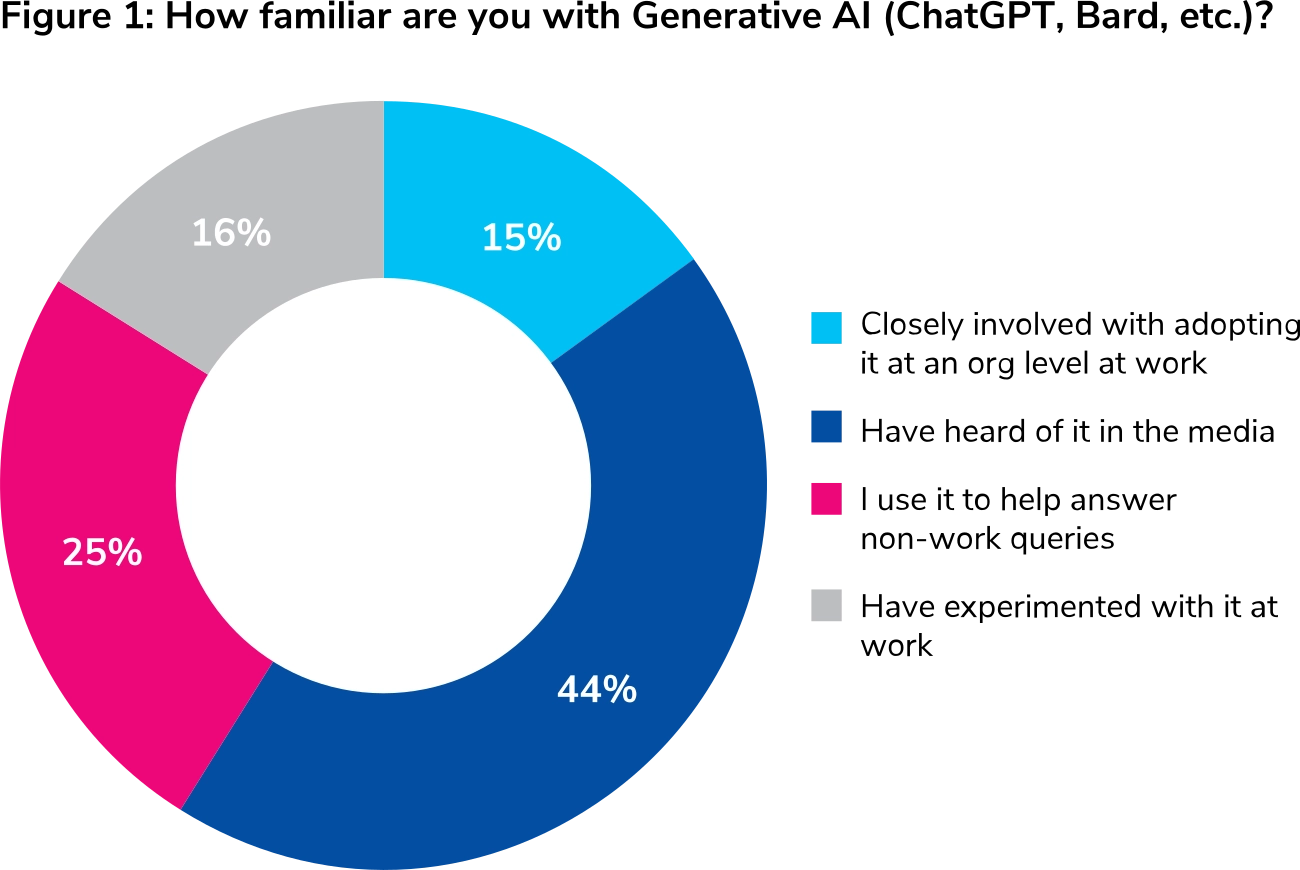
To gauge our audience’s familiarity with Gen AI, we conducted a poll that unfolded intriguing results: Nearly 1/3rd of the audience is either closely involved with adopting it at an org level at work or has experimented with it at work (Figure 1).
6 use cases of Generative AI in Safety and Pharmacovigilance
At Indegene, we have been running various pilot use cases across the value spectrum of life sciences, specifically within medical and safety areas. We used a combination of Gen AI and other models, which were designed and trained by Indegene PV domain experts to produce reasonably accurate results in simulated contexts that mirror real-world use. These use cases range from enhancing AE intake processes to generating high-quality content for aggregate reports.
Watch the webinar recording embedded in this blog to see Dr. Shubha demonstrate two of the above use cases.
In the early stages, there was a lot of sensitivity, especially around data privacy and security. Now organizations are working with large tech partners to set up a secure environment and infrastructure and run pilots. Healthcare organizations are seeing the same opportunity as other industries. Efficiency improvement and opportunities for augmentation v/s replacement have been a big theme.
– Tarun Mathur
CTO, Indegene
4 pitfalls to be mindful of – Risks of using Gen AI in Pharma
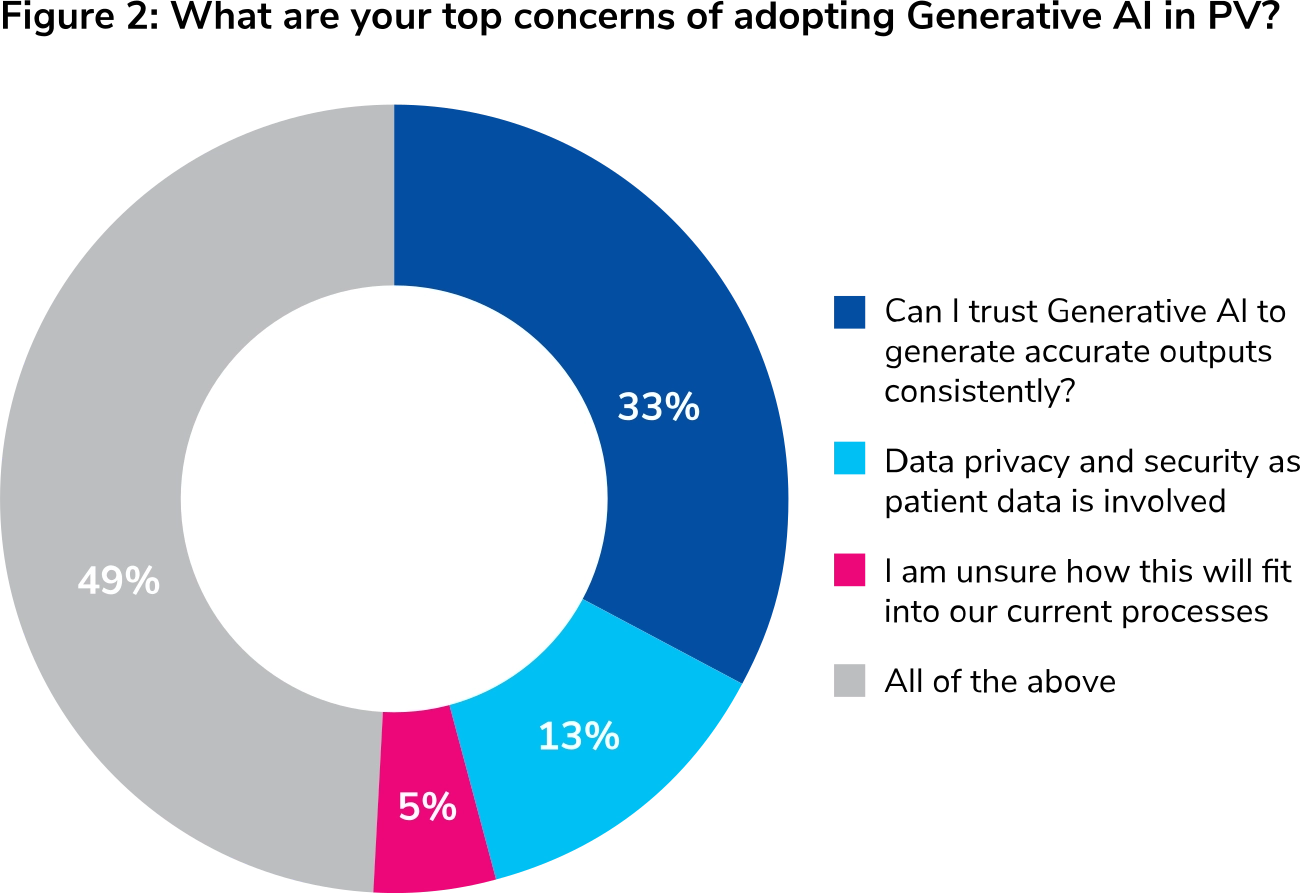
We asked the audience about their ease with adopting Gen AI and found nearly half worried about Gen AI adoption in Pharmacovigilance, citing accuracy, trust, patient data security, and integration uncertainty. (Figure 2).
Our panelists addressed 4 potential pitfalls (Image-1) associated with Gen AI. Ensuring quality and consistency of results, safeguarding data privacy and security, establishing trust mechanisms, and maintaining regulatory compliance are crucial factors to consider. Sandeep elaborated on Microsoft's commitment to data privacy and security, ensuring that sensitive patient data remains within the network.
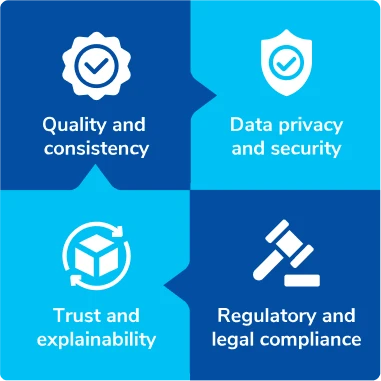
Image 1: Four potential pitfalls associated with Generative AI
While the experiments show promise, there is substantial effort required to productionalize them. Rigorous validation of the results, refining the instructions, and fine-tuning the models will be required to ensure we get consistent and accurate results. Additional quality checks and process redesign will be required while working with Gen AI-based outputs.
– Dr. Shubha Rao
Senior Director, Safety, Indegene
Guiding success: 2 considerations for implementation
Today, most PV tasks, be it case assessment, aggregate report authoring, or signal & risk management, are carried out manually to a large extent. While the safety data is growing, drawing meaningful insights and separating noise from data is getting harder. Indegene’s initial experiments show that Gen AI can be instructed and trained to generate reliable and high-quality outputs in these scenarios. The two considerations critical for successful implementation are:
Model Selection and Collaboration: Partnering with domain experts and establishing toolkits and incubation pods are crucial.
Identifying Use Cases and Validation: Testing and validating Gen AI outputs through collaboration with tech and data science teams are essential.
Explore how Indegene Transforms Automated Case Intake and Processing for a Top 3 Pharma by leveraging NEXT Adverse Events Management platform for end to end case processing driven by Artificial Intelligence (AI) and Natural Language Process (NLP) technology for pharmacovigilance automation.
Explore the latest survey report on determining ROI for Generative AI use cases and securing funding
Charting the course forward
Utilizing Gen AI necessitates selecting healthcare-specific models, fine-tuning, and seamless integration. Establishing trust mechanisms and managing change is vital. In conclusion, Gen AI's transformative potential in Pharmacovigilance is promising. Prudent progress, addressing challenges, and fostering trust are indispensable. Collaborating with Microsoft, Indegene is committed to harnessing Gen AI's potential in PV.
Check out our recent panel discussion: 'Is Generative AI Ready to Transform Pharmacovigilance? A Look at Today’s Progress and Tomorrow’s Potential' for updated insights on AI's evolving role in Pharmacovigilance.